MokuScience
Making the invisible visible through mathematics, physics and motion.
Field | Detail |
|---|---|
Type | Creative research |
Status | Active |
Category | Creative Research, Data Visualisation, Scientific Visualisation, 3D Graphics & Animation |
Stack | Blender 5.2 (headless), Python, Claude Code |
Output | MP4 (vertical 9:16, horizontal 16:9) |
Timeline | October 2026 to present |
Studio | Mokujiro Studio |
Creative director | Ken Tai |
A curiosity shaped by data visualisation
Throughout my design career, I have consistently worked with data visualisation. Turning information into something visible has been a recurring source of curiosity and motivation to learn.
I have always been interested in how complex concepts and the mechanisms behind phenomena we cannot directly see can become understandable through visual representation.
In data visualisation, what matters most to me is that people can do more than understand intuitively: they can organise the information efficiently in their minds and naturally grasp its relationships and the whole picture. Visual appeal matters, but every element in a visualisation must have a purpose. Beauty should not be added as decoration. It should emerge naturally from the information itself.
I value simplicity, clarity and the removal of unnecessary elements. What matters is that people can intuitively recognise what they are looking at, without the visual presentation getting in the way of understanding. This means carefully considering information structure, visual hierarchy and the role of every individual element.
MokuScience builds on this background in data visualisation, extending my visual practice into 3D graphics and animation as additional ways to explore and communicate ideas.
Making equations visible
MokuScience is an ongoing series of visual experiments exploring the principles of mathematics and physics through data visualisation, 3D graphics and animation.
It brings together different forms of visual representation. Data visualisation helps reveal numerical relationships and patterns, while 3D graphics and animation allow mathematical structures and physical phenomena to be explored through form, space and motion.
From Newton's laws of motion to wavefunctions, probability and quantum entanglement, I explore how the phenomena and relationships described by mathematical equations can be represented visually.
My interest is not simply in turning equations into images. It is about understanding the rules and structures they describe, then making visible how those rules take shape, move and interact.
I build computational models based on mathematical principles. Depending on the subject, the results may be explored through data visualisation, translated into 3D forms, or brought to life through animation in Blender. Rather than adding visual effects afterwards, the underlying mathematical and physical rules determine what appears on screen.
Equations generate images, and those images deepen understanding. This is the central idea behind MokuScience.
From an idea to a visual experiment
Each experiment begins with learning about a subject and understanding its fundamental principles.
I then work towards explaining the concept in the simplest possible way. One question I often ask myself is whether I could explain it to a ten-year-old.
I break complex ideas into smaller elements and arrange them in a sequence, much like turning the pages of a picture book, where each page builds on the one before it.

From there, I develop a narrative and translate it into a visual sequence. What should be seen? What changes? When should the camera move? I carefully consider timing and perspective so that the viewer can follow the concept naturally.


Computational modelling
I use Python and Blender to create the visual experiments.
Python is used to implement mathematical models and computational processes. The results are then translated into form and motion in Blender. I also control Blender through scripts in background mode to generate scenes and animations based on the underlying models.
AI tools such as Claude Code support the process through code generation, refinement, research and problem-solving.
However, AI does not determine the concept or the creative direction. The choice of subject, the learning process, visual language, composition, movement and final creative decisions remain my own.
Validation and refinement
When working with science and mathematics, visual representation alone is not enough. The accuracy of the underlying model matters just as much.
I check computational results against the relevant equations and principles, and validate the models where necessary. I also distinguish between direct representations of scientific phenomena and simplified visual explanations designed to make a concept easier to understand.
The process is rarely finished in one attempt. I learn, build a model, visualise it, validate it and refine it. Through this cycle, my own understanding continues to develop.
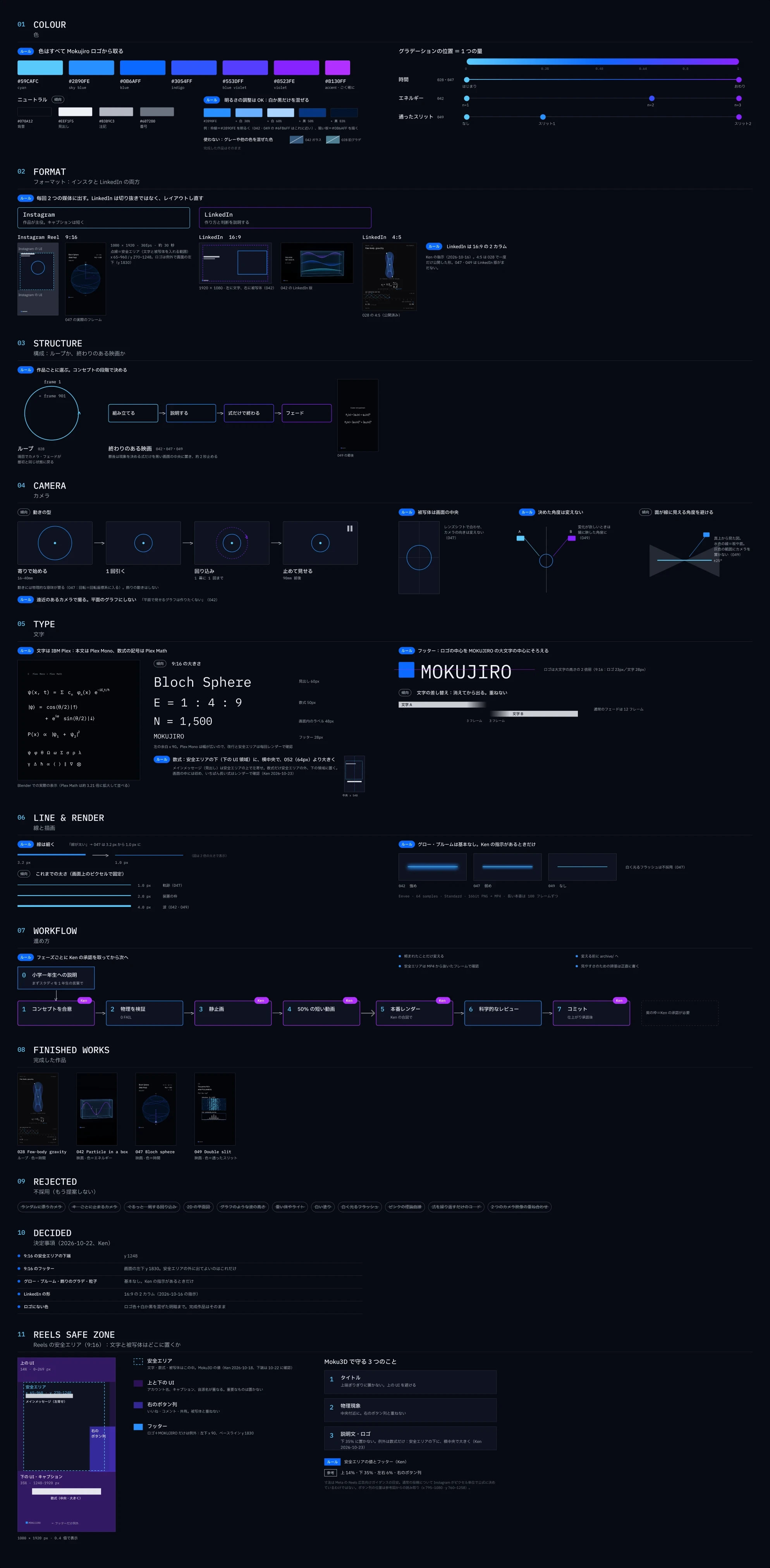
A visual language built on clarity
MokuScience follows a consistent approach to visual expression.
Accuracy first: Represent the underlying principles and rules before considering appearance.
Purposeful elements: Give every shape, colour and movement a clear role.
Visual restraint: Remove elements that do not contribute to understanding.
Clear hierarchy: Make it intuitive to recognise what matters.
Intuitive perception: Use visual relationships to make complex ideas easier to grasp.
A sense of discovery: Leave room for viewers to notice new relationships and meanings.
The aim is not to make complex things look simple. It is to reveal the structures within that complexity and communicate them in a way people can understand.
Adding another layer of understanding
As AI evolves, advanced computation and analysis that were once accessible mainly to specialists are becoming increasingly familiar. Emerging technologies such as quantum computing are also introducing new possibilities beyond the established approaches to computing and information processing.
I believe technological progress will do more than improve the systems we already have. By introducing concepts and ways of thinking that we have not previously used, it may fundamentally change how we live and how society works.
I am interested in these possibilities, but before exploring what they might lead to, I wanted to revisit the fundamentals and learn them for myself.
MokuScience is part of that process. It is an opportunity to study established knowledge, understand the principles behind it and reconsider them from a different perspective. By making invisible relationships visible, I hope to add another layer to the way we understand the world.
An ongoing exploration
MokuScience is not a single project with a defined end point. Each subject leads to another question, and each question opens the door to a new experiment.
Every study is a record of what I have learned, how I have made sense of it and how I have translated that understanding into a visual form.
The goal is not to reach a predetermined destination. It is to keep learning, questioning and making.
Making the invisible visible.